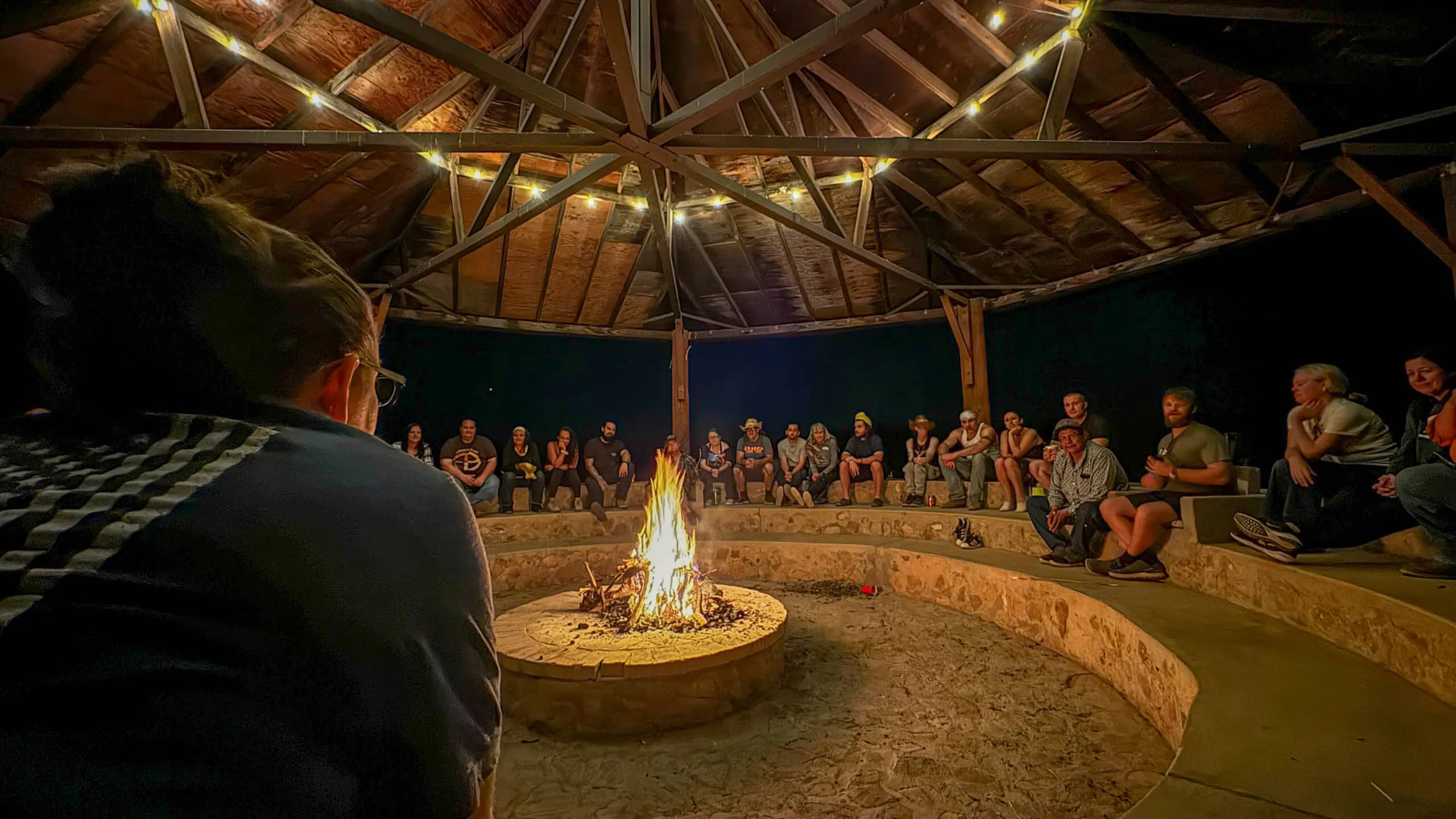
The Forward-Facing® Accelerated Recovery (FF-AR) model is an integrative, salutogenic approach to treating trauma and addiction simultaneously — grounded in the understanding that addiction is a post-traumatic adaptive capacity, not a pathology to be eliminated. FF-AR addresses both at once without overwhelming the nervous system: rather than intensive memory processing early in recovery, it emphasizes neuroception, interoceptive awareness, and the gradual expansion of capacity as the foundation of healing and relapse prevention.
We prioritize the safety of our client's nervous system and listen to the stories of the nervous system. We create environments where people feel physically and psychologically secure, recognizing that trauma impacts safety needs.
2
Trustworthiness and Transparency
We build trust by keeping decisions, expectations, and procedures concise and predictable for clients and staff. We integrate healing practices into our own lives and leadership, recognizing our nervous-system regulation as the miracle intervention.
3
Connection and Community
We value the healing power of connection and lived experience. Peer support is rooted in community, mutual understanding, and shared humanity. Our staff are encouraged to engage in their own healing journeys so they can offer authentic presence and empathy — honoring that no one heals in isolation.
4
Collaboration
Healing is a shared process grounded in partnership and respect. We intentionally share power, honor lived experience, and recognize that healing happens through relationships, not in a hierarchy. By focusing on a person’s history of survival and movement through trauma, we understand behaviors as expressions of capacity and competency rather than pathology or disease.
5
Empowerment
We center choice, voice, and personal agency by emphasizing strengths, resilience, and the innate capacity for active adaptation. We view health as a continuum and healing as a process of incremental movement toward greater wellbeing and functionality. We listen for competence and capacity within each person’s story to support transformation toward health rather than defining individuals by pathology or brokenness.
6
Cultural, Historical, and Gender Responsiveness
We honor the whole person by recognizing how culture, identity, history, and lived experience shape healing. This includes acknowledging the impact of historical harm, discrimination, and intergenerational trauma. We work with humility to reduce bias, listen deeply, and offer care and connections that respect each person’s background and dignity, enhancing their sense of belonging.
The Clinical Gap
Why traditional models fall short.
Trauma and addiction have historically been treated as separate clinical domains. Trauma-focused therapies often rely on exposure and memory processing, which may destabilize individuals in early recovery by increasing arousal and craving activation. Meanwhile, substance-use treatment prioritizes stabilization, often delaying trauma work indefinitely.
This creates a clinical gap where trauma remains unaddressed while addiction persists. The ACE study demonstrated that individuals with higher adverse childhood experience scores show significantly increased risk for both addiction and mental health challenges — confirming what our clinicians see every day: these conditions cannot be separated.
Reframing Addiction
Addiction is a post-traumatic adaptation, not a moral failure.
Substance use is a functional adaptation— a way the nervous system regulates overwhelming emotional and physiological states. Dissociation, numbing, modulation. It worked, until it didn’t.
Trauma disrupts interoception, emotional regulation, and autonomic functioning. When we recognize addiction as an adaptive capacity rather than a character defect, shame loses its hold — and genuine, lasting healing becomes possible.
0%
of adults report at least one Adverse Childhood Experience
0.0x
elevated risk of opioid addiction at four-plus ACEs
0x
elevated risk of alcoholism among those with high ACE scores
Source · ACE Study (CDC / Kaiser Permanente)
The Forward-Facing® Accelerated Recovery Approach
Stabilize. Understand. Grow.
Salutogenesis, introduced by Aaron Antonovsky in 1979, provides an evolutional paradigm shift from a traditional focus on pathology to the active creation of health. Central to this model is the concept of a Sense of Coherence (SOC). Forward-Facing® Accelerated Recovery (FF-AR) operationalizes these salutogenic principles in a treatment structure — creating the neurological foundation needed for deep, lasting change.
The three domains — Comprehensibility, Manageability, and Meaningfulness — are drawn from Aaron Antonovsky’s Sense of Coherence (1979, 1987), the foundational work on salutogenesis.
01
Comprehensibility
See the pattern.
Build a coherent understanding of your nervous system. Learn to recognize the threat response and how to interrupt it. Urges and cravings become predictable responses to dysregulation — not failures of willpower.
02
Manageability
Regulate from within.
Cultivate self-regulation through neuroception, interoception, and acute relaxation strategies. Interrupt adaptive threat responses to return to physiological safety — so emotional regulation and behavioral effectiveness become reachable states, not distant ideals.
03
Meaningfulness
Move toward what matters.
Develop a personal code of honor, a mission statement, and a vision for your recovery. Engage life's challenges as purposeful and worth sustained investment — intentional, values-driven living.
Wisdom From the Work
What trauma-informed recovery sounds like, in four frames.
“Trauma healed in isolation becomes trauma repeated. Healed in community, it becomes wisdom.
On community as medicine
“Horses mirror what words cannot — they feel the body’s truth before the mind catches up to it.
On equine-assisted work
“The nervous system listens to rhythm long before it listens to reason.
On somatic practice
“The opposite of addiction is not sobriety. It is connection.
Johann Hari
Clinical Modalities
How we deliver Forward-Facing® Accelerated Recovery care.
In our residential setting, treatment is delivered through an integrated combination of clinical modalities — all aligned with the Forward-Facing® Accelerated Recovery framework and trauma- informed principles of safety, empowerment, and collaboration.
Primary Therapeutic Framework
Forward-Facing® Accelerated Recovery Treatment
Our primary therapeutic framework — a present-focused, salutogenic model that prioritizes nervous-system regulation, meaning-making, and strengths-based care. Clients build capacity through breathwork, somatic awareness, and attentional practices before engaging deeper trauma processing.
“The body holds what the mind has not yet spoken.”
Somatic Experiences
Trauma lives in the body as much as in the mind. Somatic experiences tune the nervous system back into its own capacity for self-regulation — especially effective for complex trauma.
Polyvagal-Informed Care
Drawing on Polyvagal Theory, clinicians help clients recognize fight, flight, freeze, and social-engagement states — the foundation for interrupting threat responses.
Psychoeducation & Reframing
Clients learn urges and cravings through the intrusion, arousal, avoidance cycle — reframing substance use as a predictable dysregulation response, not a failure of willpower.
Experiential & Community Groups
FF-AR is delivered through psychoeducation, experiential groups, and community engagement. Shared experience builds the relational connection required for healing.
Body-Based Interventions
Breathwork, movement, equine-assisted experience, and sensory grounding reconnect clients with their physical selves — the resilience that carries recovery forward.
Beyond Recovery
From surviving to thriving.
Forward-Facing Accelerated Recovery does not stop at symptom reduction. The model actively supports post-traumatic growth — increased resilience, deeper meaning, and strengthened relational connection. A paradigm shift from managing illness to actively creating health.
0%
of clients complete our 90-day residential program
0%
report sustained sobriety at the 12-month alumni check-in
0.0/5
Google rating across verified alumni & family reviews
Start Here
You don’t have to carry this alone.
Our admissions team can verify your insurance and walk you through intake, often within 24 to 48 hours. Same clinicians. Same land. Same quiet confidence that healing is possible.
Most major insurance plans cover addiction treatment. Share your details (and snap a photo of your card if you have one) and we’ll verify your benefits and call you back — typically within 15 minutes.
4.8/5 Google Rating · 29 reviews•"I am a dual diagnosis." — Boots•Small Census · Every Name Known•"Five stars aren’t enough to express that going to treatment at Seven…" — Kelly J.•NEW: When Drinking Stops Working →•"This place is truly special." — Zach M.•90+ Day Programs Available•"Seven Arrows saved my life." — Krisitin G.•24/7 Admissions Support•JCAHO Accredited • LegitScript Certified•
4.8/5 Google Rating · 29 reviews•"I am a dual diagnosis." — Boots•Small Census · Every Name Known•"Five stars aren’t enough to express that going to treatment at Seven…" — Kelly J.•NEW: When Drinking Stops Working →•"This place is truly special." — Zach M.•90+ Day Programs Available•"Seven Arrows saved my life." — Krisitin G.•24/7 Admissions Support•JCAHO Accredited • LegitScript Certified•